With all the press the bulldog trait has received, it is common for any stillborn Dexter fetus to be called a bulldog by the breeder; regardless of cause, or presence/absence of deformity. Generally, these events are blessedly rare, so it is difficult for a breeder to compare his loss with other breeders. The fetus is promptly buried, no photos taken, and no DNA samples obtained. Of course, fetal death can be caused by a number of events, including infection, certain plants, and trauma to the fetus from cows fighting, especially in horned cattle kept in confinement.
However, there are two known lethal genetic mutations that appear to be unique to Dexter cattle. They are commonly termed “bulldog” calves and “waterbabies.” Before the advent of genetic testing, many people believed they were variations on the same defect. This confusion delayed the understanding of chondrodysplasia because animals that did not appear affected by chondrodysplasia, (i.e. did not have short legs and a “choppy” gait) could still produce a waterbaby. This led to the false belief that “dwarfism” and “bulldog” calves were not entirely linked. (For more infomation and a list of all the names used to refer to dwarf and non-dwarf Dexters, please see the article Short-legged and Long-legged Dexters.)
First, a little background. Genes come in pairs, called alleles. An animal that has two different alleles for a gene is called heterozygous, one that has two identical alleles is called homozygous. These terms are reused for every gene. So, an animal can be homozygous normal for chondrodysplasia, but be heterozygous for pulmonary hypoplasia.
Dominant means one allele for the trait will change the outward appearance of the animal. This is further defined by the term Co-Dominant, which means one allele for the trait will change the outward appearance a little bit, but two alleles for the trait will change the appearance a lot. (Clinicians often call these individuals affected and severely affected, using the outward appearance to determine how many mutant alleles the individual possesses.)
Recessive means that one allele for the trait will not change the outward appearance of the animal, this is a true “carrier.” In this case, it takes two alleles for the trait to make a change in the animal.
Breeders often maintain that any bad genetic trait discovered in their breed “must be” from some wicked introduction by another breed. But mutations happen. Most go unnoticed. Occasionally, a mutation is actually advantageous. Mutations create variations in animals, and that allows species to survive environmental changes. But some mutations, known as genetic lethals, cause the death of animals that are homozygous for the trait.
Bulldogs:
Bulldog calves are caused by chondrodysplasia, a form of dwarfism. A rough, literal translation of the term chondrodysplasia is “cartilage in bad form.” Chondrodysplasia is a co-dominant trait, so the heterozygous animal with one mutant allele outwardly shows some signs of the trait. The ability to distinguish these animals from the rest of the herd allowed many breeders to eliminate the occurrence of bulldog calves from their herd; before a genetic test became available.
Several laboratories provide testing for this mutation including UC Davis and Texas A & M. The following is an explanation of the abbreviations breeders will see on their lab certificate after submitting a hair sample for DNA testing.
- A Homozygous Normal (HN) animal has two normal alleles for the chondrodysplasia gene and appears normal. (Figure 1)
- An animal that is Heterozygous for Chondrodysplasia (HC) has one mutant allele and one normal allele. This animal is affected by the mutation and will show some signs of chondrodysplasia such as short legs and a choppy gait. It will be born alive, but has the potential to produce bulldog calves. Some may suffer from difficulties due to tracheal malformations, poor feet, or arthritis. (Figures 2, 3)
- An animal that is Homozygous for Chondrodysplasia will be severely affected,(SA) and typically is spontaneously aborted (miscarried). It will have the appearance of a bulldog calf, including a shortened muzzle, domed forehead, and very, very, very short legs. The “guts hang out” through a pronounced abdominal hernia and the animal has a cleft palate. The spine is also shortened and the rib cage is small which may compress the lungs, causing some edema in calves carried close to full term, but overall the fetus has a very different appearance than a waterbaby. Although calving difficulties do occur, most bulldog fetuses are delivered without assistance. (Figures 4, 5)
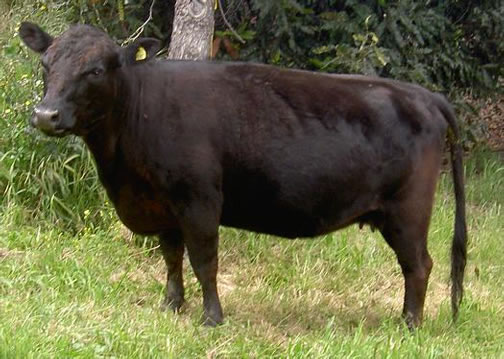
Figure 1 - Homozygous Normal (HN) Dexter.
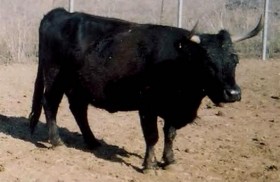
Figure 2 - Dexter affected by chondrodysplasia (HC).
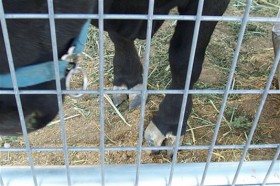
Figure 3 - Poor foot and lower leg conformation on a chondrodysplastic (HC) Dexter.
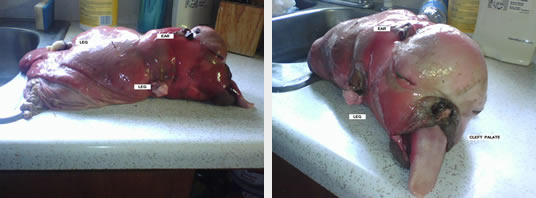
Figure 4, 5 - Severely Affected (SA) dun colored bulldog calf. Notice the extremely short legs, tiny ears, cleft palate, and abdominal hernia.
It is believed that all chondrodysplastic Dexters in North America share the same mutation. This allele is also common in “Mini” cattle types created from Dexter stock, where affected animals were actually favored over normals.*
Waterbabies:
Waterbabies are caused by Pulmonary Hypoplasia Anasarca, (PHA). The term pulmonary hypoplasia means the lungs are underdeveloped and anasarca refers to edema (swelling) at birth. PHA is believed to be a recessive trait, meaning animals that are carriers of the mutation cannot be identified unless they produce a waterbaby, or are genetically tested.
- A homozygous normal animal has two normal alleles for the pulmonary hypoplasia gene.
- An animal that is heterozygous for pulmonary hypoplasia is believed to show no outward signs.
- An animal that is homozygous for pulmonary hypoplasia will have little or no lung tissue which causes it to swell up with fluid looking much like a cartoon character that has swallowed a water hose. This tremendous swelling is the most distinguishing characteristic. It does not have the short legs, cleft palate, and other deformities of the bulldog. The dam might have a swollen belly prior to calving due to an excess of amniotic fluid, and may need a cesarean section to remove the calf because it has swollen too large for vaginal delivery. (Figures 6,7)
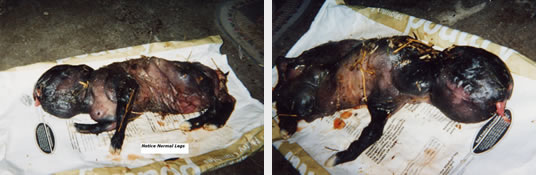
Figure 6, 7. Waterbaby calf caused by PHA - Notice normal leg length, and an extremely swollen head that makes it difficult to see the eyes and nose. The animal also has swelling in the torso, although in this case, the head swelling is the most pronounced.
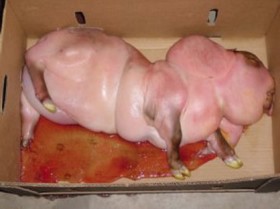
Figure 8 - This red-colored PHA "waterbaby" was not carried to term but still created a difficult calving for the mother due to edema.
The existence of PHA in other established breeds such as Maine Anjou does not imply Dexters are related to those breeds. Dexters actually have a unique mutation within the gene.
Chondrodysplasia was once very common in Dexters because breeders actually favored the appearance of the heterozygous animals, and the body type was once popular in show rings. (In some areas of the country, this is still the case.) PHA is rarer, because there was no selection process to create a market for heterozygous animals. Now that there is a test for both, the occurence of both bulldogs and waterbabies can be easy to eliminated from the breed.
You can test your animals for PHA by submitting a hair sample to UC Davis. The link is provided on this website under the Links section.
* The chondrodysplasia test will only identify one mutation, and will not identify other dwarfism mutations within the same gene, or within other genes. Other forms of dwarfism are known to exist in “Mini” cattle due to the introduction of many breeds other than Dexter, so this test is not an end-all diagnostic for dwarfism in these animals.
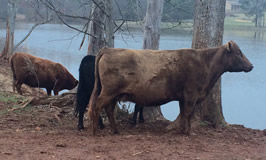

I understand that breeding a cow that IS positive for the Bulldog Gene will NOT produce a BULLDOG CALF.
However, MY QUESTION IS THIS……………..
Even though this calf IS NOT A BULLDOG calf, would THIS calf ALWAYS CARRY the BD Gene? “Would it be a carrier” so to speak? IF So,,, “IF” that calf were bred to a CARRIER BULL in “IT’S” adult life time, would it “THEN HAVE A BULLDOG CALF” as the results of “being a CARRIER” AND being bred to the carrier bull?
A dead bulldog calf has two bulldog genes, A dwarf/chondro carrier has one bulldog gene and one normal gene. If your cow is a dwarf, 1/2 the time her calf will get her normal gene, and 1/2 the time her calf will get the bulldog gene. So, even if bred to a non-dwarf/non-carrier, 1/2 of the calves from your dwarf cow will be dwarfs themselves. They will look somewhat different than the normal calves and will have one bulldog gene.
To add more to my question above…………
Would this cow WITH BDG have calves that ALSO have the gene even though bred to a NON CARRIER BULL.
Would THOSE CALVES then ALWAYS have the BDG in them and be nown as a “CARRIER” of such?
With THEM also having the possibility of HAVING a BDG calf “EVEN WHEN BRED TO A NON CARRIER” bull in the future?
Her non-carrier offspring do not carry hidden bulldog alleles. The allele is lost from their genome forever. They cannot produce a bulldog calf. The only way they can produce a carrier calf is to be bred to a bulldog carrier, (meaning the bulldog allele came from the other parent).
I have two tested NON CARRIER miniature Jerseys which just produced a presumed BD calf. Both sire (semen) and dam (live) were tested for BD1 at UCD. Is there a mutation of this gene or possibly a BD2 gene out there? I am sending a tail hair sample to UCD tomorrow and kept the dead calf in the freezer just in case they want to do a necropsy. This is the first time that we have had this and especially from tested animals. This concerns me to know that there is another gene out there that can cause this.
In this case, the calf is a heifer, legs about 6″ long, very hard curled, front and rear, bulldog face and swollen head, normal ears and tail, tongue protruding, and 5 days away from her expected due date. I have pictures if you could tell me more…thank you!
~Deb…
Most mini cow strains are influenced by the process of selecting extremely small animals that randomly appeared either within their own breed or within other breeds. This means something happened to that small calf that did not happen to his or her sire or dam. For a new mini cow project, I suppose the best case scenario is that the calf has a fresh mutation for something that made it small.* The problem with a fresh mutation is the animal is heterozygous (has one genetic copy) for the trait, because the odds of two mutations at the same location in the same animal is infinitesimal. So, if the animal shows effect of the mutation, it is clinically dominant or co-dominant in nature, meaning two animals bred together that have this new “small size gene” or even two similar new “small size genes” will have a 25% chance of producing a homozygous animal with a double dose of this trait. There are many genetic lethals known in full size cattle, and it is possible that you are experiencing one from the Jersey breed. But, since productivity and growth are selected for in commercial herds, the mutations that cause growth retardation are culled, so any sort of co-dominant dwarfism is usually selected against. In these new mini breeds, the random dwarfs are gathered up from anywhere they can be found, and bred together. So, it is not uncommon for these animals, when bred together, to produce some strange lethals. There are even cases where the sire and dam are quite unrelated and the concept of “compound heterozygote” comes into play, since they may not have the exact same mutation, but the mutations are similar enough that a calf who receives one bad gene/allele from each parent is still born dead. This concept could also result in an extremely small animal that carries two types of dwarfism, which would then be bred extensively because its size is favored.
* Another scenario in new mini cow breeds can be animals that pop out and do not have the smallness of their parents, either because:
1. A randomly small animal used as a mini cow or bull in a breeding program was small for reasons that were not genetic, such as placental insufficiency or nutritional factors during growth of the calf.
2. Two animals that had mutations for some sort of smallness factor were bred together and produced a non-affected animal (also a 25% chance), and this animal reached full size.
These concepts may be a contributing factor when calving difficulties that are reported due to an unusually large calf for the miniature strain.
I have a related question. Could a dwarf heifer be homozygous for chondroplasia and give birth to a stillborn bulldog calf even if she was bred to a non carrier bull?
No. For two reasons.
1. An animal that is homozygous for chondrodysplasia is dead. It’s a bulldog calf.
2. Let’s say chondrodysplasia is not lethal in its homozygous form. So your heifer is homozygous. She has two copies of the gene. She can only pass on one copy to each offspring. This is how DNA works. If a cow has six feet of DNA in her cells, she passes on three feet to her offspring, and the bull passes on three feet. The calf has sex feet of DNA and a fresh combination of genes.